

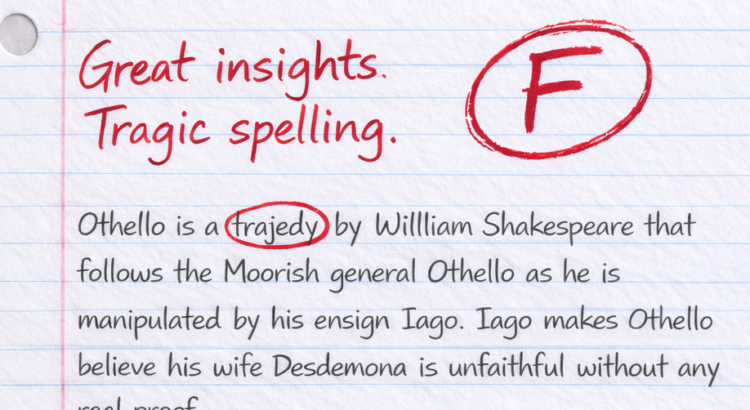
When I was in high school, I had an English teacher who felt that while nobody’s work is perfect, certain elements of our writing were non-negotiable; things that, when ignored, showed a lack of attention by the writer and a lack of respect for the reader. No matter how amazing your paper might be, if it contained three misspelled words OR one fragment sentence OR one run-on sentence, you got an F. And to make it worse, he ANNOUNCED every student’s grade, emphasizing work that would’ve merited an “A”, but instead, was given an “F.” For example: “Mister Foster (yes, he addressed us all as “mister”) found insightful meaning in Shakespeare’s Othello, but apparently lost his own dictionary. F.” It was brutal, but motivating.
I think about that class a lot these days as I watch the undeniable lowering of the communication bar. First, it was low-cost platforms where writing was reduced to a commodity because it was “good enough” for the project at hand. Fast forward to the age of AI, where $20 per month gets you a personal writer that never sleeps and continually tells you how great your ideas are. Is AI writing good? Well, it’ll fill a page. And for [insert painfully dull but necessary task here], in addition to being fast and cheap, it’s “good enough.” Or is it?
In an age where everything is expensive, it’s easy to confuse cost and value. So we seek out a low-cost or DIY approach to our tasks. But owning a saw doesn’t make you a carpenter, and there’s a difference between making a box to put stuff in and crafting a cabinet to put stuff on display. When it comes to your brand messaging, don’t stuff your story in a box where people might not even see it. Display it in a way that makes people stop and take a second look. And if you don’t know where to find such a copywriting services craftsperson…like, oh, I don’t know, a Wordsmith, just give me a shout. I know a guy with a flair for brand storytelling and an irresistible affordability-to-awesomeness ratio. Says he shapes words into works of art.