

When Did “Good Enough” Become Good Enough?

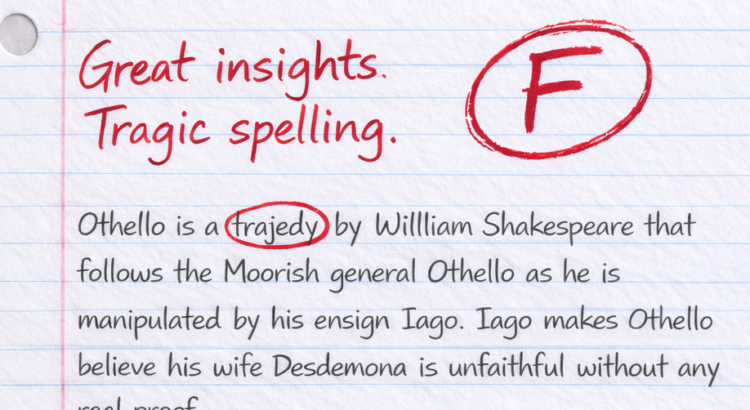
When I was in high school, I had an English teacher who felt that while nobody’s work is perfect, certain elements of our writing were non-negotiable; things that, when ignored, showed a lack of attention by the writer and a lack of respect for the reader. No matter how amazing your paper might be, if it contained three misspelled words OR one fragment sentence OR one run-on sentence, you got an F. And to make it worse, he ANNOUNCED every student’s grade, emphasizing work that would’ve merited an “A”, but instead, was given an “F.” For example: “Mister Foster (yes, he addressed us all as “mister”) found insightful meaning in Shakespeare’s Othello, but apparently lost his own dictionary. F.” It was brutal, but motivating.

I think about that class a lot these days as I watch the undeniable lowering of the communication bar. First, it was low-cost platforms where writing was reduced to a commodity because it was “good enough” for the project at hand. Fast forward to the age of AI, where $20 per month gets you a personal writer that never sleeps and continually tells you how great your ideas are. Is AI writing good? Well, it’ll fill a page. And for [insert painfully dull but necessary task here], in addition to being fast and cheap, it’s “good enough.” Or is it?

In an age where everything is expensive, it’s easy to confuse cost and value. So we seek out a low-cost or DIY approach to our tasks. But owning a saw doesn’t make you a carpenter, and there’s a difference between making a box to put stuff in and crafting a cabinet to put stuff on display. When it comes to your brand messaging, don’t stuff your story in a box where people might not even see it. Display it in a way that makes people stop and take a second look. And if you don’t know where to find such a copywriting services craftsperson…like, oh, I don’t know, a Wordsmith, just give me a shout. I know a guy with a flair for brand storytelling and an irresistible affordability-to-awesomeness ratio. Says he shapes words into works of art.

What If Your Pants Were On Backward?

If you went to a party and saw a friend wearing their pants backward, would you tell them?  What if it were you with the backward pants? Would you want someone to tell you? And if they did, how would you respond? Would you be angry for the criticism or thankful for the observation? Would you tell yourself, “This is how I’ve always worn them,” and move on? Would you change your pants but put them on the same way, or would you consider the input and ask for advice?

Growing your business demands exploring every possible opportunity to introduce yourself. But more chances to share your message create more chances to send the wrong message. Publishing content with misspelled or misused words…stumbling through an elevator speech that’s unprepared or unfocused…giving a presentation with more “um’s,” “like’s,” and “you know’s” than anyone can count…these are all very much like wearing your pants the wrong way. You may not realize it, but everyone else does. And what it says about you and your business will always overshadow your message.

Whatever your business, it’s crucial to evaluate your message and your delivery to make sure you’re standing out like a superstar, and not sticking out like a sore thumb.  Because the last thing you want to be is the person everyone’s talking about for all the wrong reasons.

The Wordsmith Can Help
If you’d like to review your messaging, I’d love to help! Drop me a message or give me a ring (920-540-3551), and let’s see what we can do to shape your story into one people love to hear and can’t wait to share.

Conversion begins with connection

Four male and female executives on their phones outside the office

I used to get upset when my teenage daughter would demonstrate what I referred to as “advantageous interpretation disorder” – a condition that causes questions to take on whatever meaning is easiest to answer. I would ask, “Do you have any homework?” My daughter would hear, “Do you have any homework you can’t finish on the bus or during lunch tomorrow?” and with a brief look up from her phone would reply, “Uhhh, no.”

Turns out, many grown-up business people have a similar condition when it comes to message development. I ask, “Who do you want to speak to?” They hear, “Who is your target market?” and respond with information like gender, age, income, marital status, or maybe a string of job titles, positions, and descriptions. And while marketing & demographic data are important, when we focus only on facts & figures, we lose sight of insights & feelings. We gain information about segments we want to capture but miss the emotions of the individuals with whom we’re trying to connect.  And in a time when people are drowning in noise, it’s meaningful messaging that stops the endless scrolling and starts the mindful questioning.

Increased conversion begins with improved connection. Focus a little less on your “what” and a little more on your “why,” and you’ll make the connection that sparks a conversation.

If you’d like to learn how, contact me to arrange a free message assessment session. Or call me at 920-540-3551, and we can talk about how to get people talking about you!